Starting Your Riding Journey Safely on UK Roads
There has never been a more exciting time to get into motorcycling in the United Kingdom. With the rising cost of living, growing road congestion in cities like London, Manchester, and Birmingham, and a surge in interest in two-wheeled travel, thousands of new riders are completing their Compulsory Basic Training (CBT) and taking to British roads every single year.
But motorcycling comes with very real risks. According to the Department for Transport (DfT), motorcyclists are consistently among the most vulnerable road users in the UK, making up a disproportionate percentage of serious casualties relative to the miles they travel. In 2024 and 2025 alone, motorcyclists accounted for roughly 19% of all road deaths in Great Britain despite representing a far smaller percentage of total traffic.
The good news? The vast majority of motorcycle accidents are preventable. Whether you have just passed your CBT, are working towards your full A licence through the Direct Access Scheme (DAS), or you have recently bought your first bike, this guide is written specifically for you.
These 10 essential motorcycle safety tips are grounded in UK law, DVSA guidance, and real-world British riding experience. Read them carefully, apply them consistently, and you will dramatically improve your chances of enjoying a long, safe, and rewarding riding career on UK roads.
Tip 1: Understand UK Motorcycle Licencing — and Follow It to the Letter
Why Your Licence Category Matters More Than You Think
Before you even think about throwing a leg over a bike, you need to be absolutely clear about what the UK law allows you to ride based on your current licence category. The DVSA's tiered motorcycle licencing system exists for a reason — it matches the power and speed of the machine to your current level of skill and experience.
Here is a straightforward breakdown of the current categories for 2026:
AM Licence (Mopeds)
The AM licence allows you to ride a moped with a maximum speed of 45 km/h (28 mph) and an engine capacity of up to 50cc. You must be at least 16 years old and hold a valid CBT certificate. This category is ideal for very young riders or those just testing the waters of powered two-wheelers.
A1 Licence (Light Motorcycles)
Available from age 17, the A1 licence permits you to ride motorcycles up to 125cc with a maximum power output of 11 kW (approximately 15 bhp) and a power-to-weight ratio not exceeding 0.1 kW/kg. This is the most popular starting point for new riders in the UK.
A2 Licence (Medium Motorcycles)
At age 19 or older, you can progress to the A2 licence, which allows you to ride bikes producing up to 35 kW (47 bhp). This licence is an excellent intermediate step and opens up a much wider range of machines, including many modern, well-regarded mid-range motorcycles.
A Licence (Unrestricted)
The full Category A licence, available from age 24 via direct access or from age 21 if you have held an A2 for at least two years, allows you to ride any motorcycle of any power output. This is the ultimate goal for most serious riders.
The Key Safety Message
Do not attempt to ride a motorcycle that exceeds your current licence category. Not only is it illegal — potentially resulting in a fine, penalty points, and invalidated insurance — but riding a machine that is significantly beyond your current skill level is one of the most dangerous things a new rider can do. Power must be earned gradually through experience and training.
Tip 2: Never Skip Your CBT — and Consider Going Beyond It
What Is the CBT and Why Is It Non-Negotiable?
Compulsory Basic Training, universally known as the CBT, is the mandatory first step for any new motorcycle or moped rider in the UK. Delivered by DVSA-approved training schools across the country, the CBT is a practical, hands-on course that typically takes one full day to complete.
The CBT covers five elements: an introduction to the course and eyesight check, practical on-site training, on-site riding, practical on-road training, and on-road riding. Only once you have demonstrated competency in all five elements will you be awarded your CBT certificate.
Your CBT certificate is valid for two years. If you have not passed your full motorcycle test by the time it expires, you will need to retake the CBT before you can ride legally on public roads again.
Should You Do More Than the CBT?
Absolutely, yes. The CBT is a solid foundation, but it is a minimum legal requirement — not a complete riding education. Many new riders find it enormously beneficial to book additional one-to-one sessions with a DVSA-approved instructor after their CBT, particularly to practise junctions, roundabouts, dual carriageways, and hazard identification in real-world British traffic conditions.
Organisations such as the Motorcycle Industry Association (MCIA) and RoSPA (the Royal Society for the Prevention of Accidents) also offer post-test advanced training schemes that are well worth exploring as you gain experience.
Tip 3: Invest in the Right Protective Gear — ATGATT Is Not Just a Slogan
All The Gear, All The Time
In the UK motorcycle community, the phrase "ATGATT" — All The Gear, All The Time — is repeated so frequently because it genuinely saves lives. When you come off a motorcycle, your body hits the road at speed. The only thing standing between you and serious injury is the gear you are wearing.
Here is what every new UK rider should have before heading out on public roads:
Helmet (Legally Required)
Wearing a helmet is not optional in the UK — it is a legal requirement under the Motor Cycles (Protective Helmets) Regulations 1998. Your helmet must meet at least one of the following approved safety standards: British Standard BS 6658:1985 with the BSI Kitemark, the UNECE Regulation 22.06 (the current standard as of 2026), or the NTA 8776 standard.
When buying a helmet, always try it on in person if possible. A helmet that does not fit correctly offers significantly reduced protection in the event of an accident. Look for a snug, even fit with no pressure points, and always check for the relevant safety certification label inside the helmet before purchasing.
Jacket
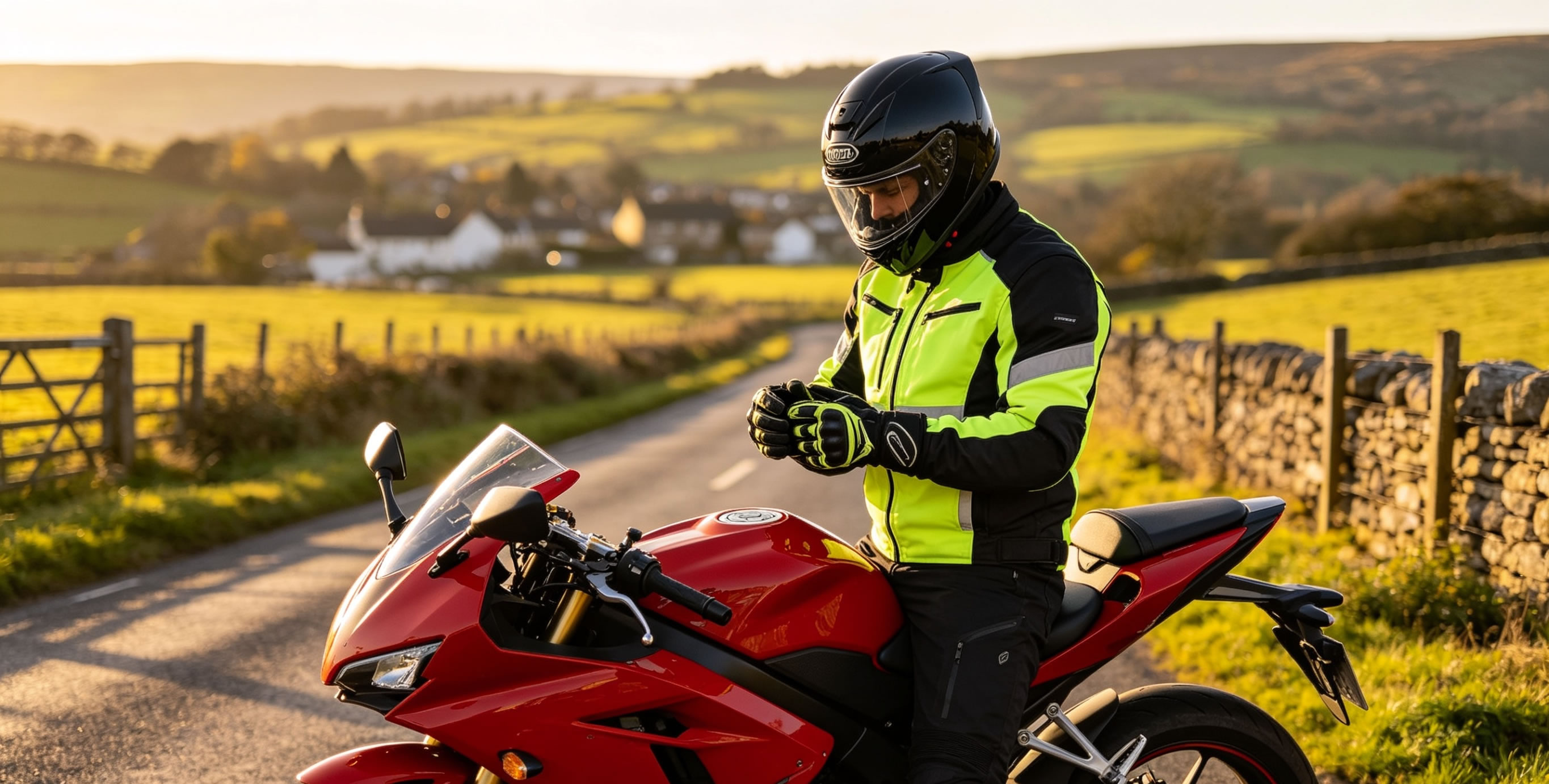
A dedicated motorcycle jacket — either leather or high-quality textile — with CE-rated armour at the shoulders and elbows and a back protector is essential. Modern textile jackets are excellent for year-round British weather and many include removable thermal liners and waterproof membranes, making them highly practical for our notoriously unpredictable climate.
Gloves
Motorcycle-specific gloves with knuckle protection and palm sliders are crucial. Your hands are instinctively the first thing you put out when you fall — unprotected hands can suffer devastating injuries on tarmac. Make sure your gloves are CE Level 1 or ideally CE Level 2 rated.
Trousers
Motorcycle trousers with integrated CE-rated knee and hip armour are often overlooked by new riders who opt for ordinary jeans. Regular denim offers virtually no abrasion resistance. Dedicated motorcycle trousers — again, available in leather or textile — provide critical protection to your lower body.
Boots
Ankle injuries are extremely common in motorcycle accidents. Purpose-built motorcycle boots with ankle support, oil-resistant soles, and toe protection are a worthwhile investment. At a minimum, wear sturdy, over-the-ankle footwear — never trainers or sandals.
High-Visibility Clothing
Though not legally compulsory in the UK, wearing a high-visibility vest or jacket — particularly in poor light, rain, or heavy traffic — significantly increases your visibility to other road users. Given that "Sorry, mate, I didn't see you" (or SMIDSY, as it is known in the motorcycling community) is one of the most common causes of motorcycle accidents in the UK, anything that makes you more visible is a worthwhile addition to your riding wardrobe.
Tip 4: Master the Pre-Ride Safety Check — Every Single Time
The POWDER Check
One of the most practical habits you can develop as a new rider is to carry out a thorough pre-ride check before every journey. In the UK, many riders use the acronym POWDER as a simple memory aid:
- P — Petrol: Check your fuel level. Running out of fuel on a busy A-road or motorway is not just inconvenient — it can be extremely dangerous.
- O — Oil: Check your engine oil level using the sight glass or dipstick, as specified in your owner's manual. Low oil can cause catastrophic engine damage very quickly.
- W — Water: If your motorcycle is liquid-cooled, check the coolant level. Many modern bikes have a transparent reservoir making this straightforward.
- D — Damage: Walk around the bike and look for any visible damage, fluid leaks, loose fasteners, or anything that looks out of place since your last ride.
- E — Electrics: Test your headlight (dipped and full beam), brake lights (front and rear), indicators, and horn. In the UK, riding without functioning lights is both dangerous and illegal.
- R — Rubber: Check your tyre pressures (using a calibrated gauge — never go by feel alone), tyre tread depth (the legal minimum in the UK is 1mm across three-quarters of the tyre width, though most experts recommend replacing tyres well before this point), and look for any cuts, bulges, or embedded objects in the tyre surface.
This check takes no more than five minutes and can genuinely be the difference between a safe journey and a serious incident. Make it a non-negotiable part of every single ride.
Tip 5: Understand and Respect the Unique Hazards of British Roads
UK Roads Present Specific Challenges for Motorcyclists
British roads are unlike roads in many other countries, and new riders need to appreciate the specific hazards that are particularly prevalent in the UK. Awareness is the foundation of hazard avoidance.
Wet and Greasy Road Surfaces
The UK's famously wet climate means that road surfaces are frequently damp, greasy, or contaminated. Wet roads significantly reduce tyre grip, increase braking distances, and make white lines, manhole covers, painted road markings, and metal drain covers extremely slippery. On a wet day, treat these surfaces as if they were ice — cross them as straight as possible and avoid braking or accelerating heavily whilst on them.
Diesel and Fuel Spills
Diesel spills are a constant hazard on British roads, particularly near junctions, petrol station forecourts, roundabouts, and layby entrances. Diesel creates an almost invisible slick that is catastrophically slippery for motorcycle tyres. Learn to recognise the rainbow-coloured sheen that diesel leaves on wet tarmac, and give these areas a wide berth wherever possible.
Potholes and Poor Road Surfaces
UK roads — particularly minor B-roads and rural lanes — are often plagued with potholes, surface cracking, and uneven tarmac patches. What a car driver might barely notice can throw a motorcycle wildly off course. Always scan the road surface well ahead and adjust your speed accordingly, particularly on unfamiliar routes.
Mud on Country Lanes
If you ride through rural areas — and many new riders enjoy the freedom of quiet country roads — be acutely aware of mud, leaves, and agricultural debris on the road surface, particularly in autumn and winter. A single patch of mud on a sharp bend can be enough to cause a serious accident.
Horses and Agricultural Vehicles
Rural UK roads are also shared with horses, cyclists, and large agricultural vehicles. When approaching a horse from behind, slow right down, cut your engine noise where safely possible, and pass extremely wide and slow. A startled horse can react unpredictably and cause a serious accident.
Tip 6: Adopt the Correct Riding Position and Use the Observation-Signal-Manoeuvre (OSM) Routine
Positioning on the Road
One of the most important skills a new UK rider needs to develop is the use of effective road positioning. Unlike car drivers, motorcyclists can and should actively use their position within a lane to maximise their visibility, improve their sightlines around bends and junctions, and make themselves more visible to other road users.
In the UK, the standard approach — as taught in the Highway Code and by most advanced riding organisations — divides the lane into three general positions:
- Position 1 (Primary): Roughly in line with the right-hand wheel track of a car — this is used to increase your visibility and discourage drivers from overtaking in dangerous situations.
- Position 2 (Secondary): Roughly in line with the left-hand wheel track of a car — this is the default riding position in most situations and offers a good balance of safety and visibility.
- Position 3 (Far left): Close to the left-hand kerb — generally avoided unless slowing to stop, as it increases your exposure to road debris and reduces your escape routes.
The OSM/PSL Routine
Every time you intend to change your road position, turn, or perform any manoeuvre in the UK, you should follow the Observation-Signal-Manoeuvre (OSM) routine, broken down further into Position-Speed-Look (PSL):
- Observation: Check your mirrors and blind spots.
- Signal: Signal your intentions to other road users if appropriate.
- Manoeuvre: Then and only then, adjust your Position, Speed, and take a final Look before executing the manoeuvre.
This routine is fundamental to safe riding on UK roads and is the basis on which your Module 2 practical test will be assessed by the DVSA examiner.
Tip 7: Always Maintain a Safe Following Distance and Adjust Your Speed for Conditions
The Two-Second Rule — and Why Motorcyclists Should Double It
The UK Highway Code recommends a minimum two-second gap between your vehicle and the one in front in normal, dry conditions. For motorcyclists — especially new riders — a four-second gap is far more appropriate. Here is why:
A motorcycle's stopping distance is comparable to a car's in ideal conditions, but a motorcyclist's ability to anticipate and react to sudden hazards is still developing in the early months and years of riding. A greater following distance gives you more time to identify hazards, more space to brake safely, and more options for evasive manoeuvring if the worst happens.
In wet weather, on greasy surfaces, or in poor visibility — all extremely common conditions on British roads — double your following distance again. Your stopping distance can increase by up to 50% on a wet road compared to a dry one.
Speed and Riding to the Conditions
The UK national speed limit for motorcycles on single carriageway roads is 60 mph and 70 mph on dual carriageways and motorways — the same as for cars. However, the legal limit is always the maximum, never the target. On a wet, foggy November evening on a winding B-road in the Peak District, riding at 60 mph could be completely inappropriate and extremely dangerous, even though it is technically within the speed limit.
Always ride at a speed that allows you to stop safely within the distance you can see to be clear. This principle — riding within your vision — is one of the most fundamental concepts in motorcycle safety and one of the things DVSA examiners and advanced riding assessors look for most closely.
Tip 8: Be Acutely Aware of Other Road Users — Especially at Junctions
Junctions Are Where Most UK Motorcycle Accidents Happen
Statistically, junctions are the most dangerous locations for motorcyclists in the United Kingdom. The most common type of serious motorcycle accident in the UK involves a car driver pulling out of a side road or turning across the path of an oncoming motorcyclist — precisely the SMIDSY scenario mentioned earlier in this guide.
As a new rider, approaching every junction with heightened caution and an expectation that not every driver will see you is not paranoia — it is smart riding. Here are some specific strategies to apply at UK junctions:
- Reduce your speed early as you approach any junction, even when you have priority.
- Cover your brakes — move your right hand fingers to hover over the front brake lever and your right foot to the rear brake pedal so you can react instantly.
- Make eye contact with drivers waiting at junctions where possible. If a driver is looking at you, they are far less likely to pull out.
- Look for tell-tale signs that a vehicle is about to pull out: rotating front wheels, the car edging forward, exhaust smoke suggesting the engine is running, or a driver's head turning to look in the opposite direction to you.
- Do not rely on your right of way. Having priority means nothing if you are involved in a collision. Be prepared to give way even when you legally should not have to.
Filtering Through Traffic
Filtering — riding between lanes of slow-moving or stationary traffic — is legal in the UK, unlike in some other countries. However, it requires significant skill and situational awareness and is not recommended for brand new riders. If you do choose to filter, the key rules are: only do so when traffic is genuinely slow or stationary, filter at a speed no more than 10–15 mph faster than surrounding traffic, and be particularly cautious near junctions, bus stops, and gaps in queuing traffic where vehicles may pull out without warning.
Tip 9: Ride Sober, Rested, and with a Clear Head — Every Single Time
Impairment Is One of the Biggest Killers on UK Roads
This tip may seem obvious, but it bears stating clearly and emphatically: never ride a motorcycle under the influence of alcohol or drugs. The UK drink-drive limit is 80 milligrams of alcohol per 100 millilitres of blood in England, Wales, and Northern Ireland, and a stricter 50 milligrams per 100 millilitres in Scotland. However, for motorcyclists — particularly new riders — any alcohol consumption before riding is inadvisable. Alcohol affects reaction times, spatial awareness, balance, and decision-making — all critical skills for safe motorcycling.
Drug driving — including the use of certain prescription medications that impair your ability to ride — is also illegal under the Drug Driving (Specified Limits) (England and Wales) Regulations. If you are taking any prescription medication, check with your GP or pharmacist whether it is safe to ride whilst doing so.
Fatigue: The Silent Risk
Rider fatigue is a significantly underestimated hazard, particularly on longer journeys. Unlike driving a car, riding a motorcycle is a physically and mentally intensive activity. After sustained periods of concentration, reaction times degrade and attention lapses become more frequent.
On longer rides, take a break of at least 15 minutes for every 1.5 to 2 hours of riding. On motorways — which new UK riders can access once they have passed their full test — the monotony of riding in the same lane at the same speed for extended periods can induce a state of highway hypnosis that is particularly dangerous on two wheels.
Emotional State
Riding angry, upset, or severely stressed is also a genuine risk factor that many new riders underestimate. If you have had a difficult day, a heated argument, or are feeling emotionally overwhelmed, consider whether you are truly in the right mindset to ride safely. There is no shame in choosing not to ride on a day when your head is not in the right place.
Tip 10: Invest in Ongoing Training and Join the UK Motorcycling Community
Passing Your Test Is the Beginning, Not the End
One of the most important things to understand as a new UK motorcycle rider is that passing your CBT or your full licence test is not the end of your safety education — it is very much the beginning. Many serious motorcycle accidents in the UK involve relatively newly qualified riders who overestimate their skills during the first year of riding. This phenomenon is so well documented that it even has a name: the "accident hump" that occurs in months six to eighteen of a rider's career, once the initial caution of being new wears off and before genuine experience has been fully built.
Advanced Riding Qualifications in the UK
The UK has some of the finest advanced rider training organisations in the world. Consider pursuing one of the following after passing your test:
- IAM RoadSmart (Institute of Advanced Motorists): The UK's largest road safety charity offers motorcycle observer sessions and a nationally recognised advanced riding test based on the principles of Roadcraft — the Police Rider's Handbook.
- RoSPA Advanced Drivers and Riders: Similar to IAM RoadSmart, RoSPA offers a rigorous advanced riding assessment with Gold, Silver, and Bronze grades.
- BikeSafe: A police-led motorcycle safety initiative available across many UK police forces, consisting of a one-day assessed ride with police motorcyclists followed by a debrief and safety advice session.
Join a Club or Riding Group
Joining a local motorcycle club or riding group is one of the most enjoyable and educational things a new rider can do. Riding with more experienced riders, observing their techniques, and learning from their knowledge and experience is invaluable. The UK has an incredibly vibrant and welcoming motorcycling community — from sport bike clubs to touring groups, adventure riding communities, and everything in between.
Keep Your Bike Serviced
Finally, keep up with your motorcycle's manufacturer-recommended service intervals. A well-maintained machine is a safer machine. If you are not yet confident carrying out your own maintenance, use a reputable DVSA-approved garage or a specialist motorcycle mechanic. Never ignore warning lights, unusual noises, or changes in your bike's handling — these are your machine's way of telling you something is wrong.
Summary: Your 10 Essential Motorcycle Safety Tips for UK Riders in 2026
- Understand your UK licence category and ride only what you are legally permitted to ride.
- Complete your CBT and invest in further training beyond the minimum requirements.
- Wear full, appropriate protective gear on every single ride — ATGATT.
- Perform a thorough POWDER pre-ride safety check before every journey.
- Recognise and respect the unique hazards specific to British roads and weather.
- Use correct road positioning and the OSM/PSL routine on every manoeuvre.
- Maintain a safe following distance and always ride to the conditions.
- Be extra vigilant at junctions and understand the risks posed by other road users.
- Never ride under the influence of alcohol, drugs, or severe fatigue.
- Pursue ongoing advanced training and engage with the UK motorcycling community.
Final Thoughts: Ride Safe, Ride Smart, Ride Long
Motorcycling in the UK is one of life's great pleasures. There is nothing quite like the freedom of riding through the Highlands of Scotland, along the sweeping coastal roads of Cornwall, or carving through the bends of the North Yorkshire Moors on a clear summer morning. But that freedom comes with responsibility — to yourself, to the other people who love you, and to the other road users you share the road with.
By taking the safety tips in this guide seriously, staying humble about your skill level, investing in proper training and gear, and never becoming complacent, you will give yourself the best possible chance of enjoying everything British motorcycling has to offer for many, many years to come.
Stay safe out there. Ride well. And welcome to one of the most rewarding communities in the UK.
Frequently Asked Questions (FAQ)
Do I legally have to wear a helmet when riding a motorcycle in the UK?
Yes. Wearing a helmet that meets current UK safety standards is a legal requirement for all motorcycle and moped riders in England, Scotland, Wales, and Northern Ireland. Failure to wear a helmet can result in a fixed penalty fine and penalty points on your licence.
Can I ride on the motorway with just a CBT certificate in the UK?
No. Riders holding only a CBT certificate are not permitted to ride on motorways. You must have passed your full motorcycle test (Module 1 and Module 2) before you are legally allowed to use UK motorways on a motorcycle.
How long is a CBT certificate valid for in the UK?
A UK CBT certificate is valid for two years from the date of issue. If you have not passed your full motorcycle test within those two years, you must retake and pass the CBT again before continuing to ride legally on public roads.
Is motorcycle filtering legal in the UK?
Yes, filtering (riding between lanes of slow-moving or stationary traffic) is legal in the UK. However, it must be carried out safely and responsibly. The Highway Code advises riders to filter only when it is safe to do so and at an appropriately low speed relative to the surrounding traffic.
What is the minimum tyre tread depth for motorcycles in the UK?
The legal minimum tyre tread depth for motorcycles in the UK is 1mm across three-quarters of the breadth of the tread pattern, and visible tread around the entire outer edge. However, most tyre manufacturers and safety experts recommend replacing tyres before they reach this minimum, as grip degrades significantly as tread depth reduces.
What is the best advanced riding course for new motorcycle riders in the UK?
BikeSafe — delivered by police forces across the UK — is widely regarded as an excellent starting point for newly qualified riders. For a more formal qualification, IAM RoadSmart and RoSPA Advanced Riders both offer highly respected nationally recognised advanced riding assessments.
Disclaimer: This article is intended as general guidance for new motorcycle riders in the UK. Always refer to the current edition of the Highway Code, DVSA guidance, and relevant UK legislation for the most up-to-date legal requirements. Laws and regulations may change — it is your responsibility as a rider to stay informed.