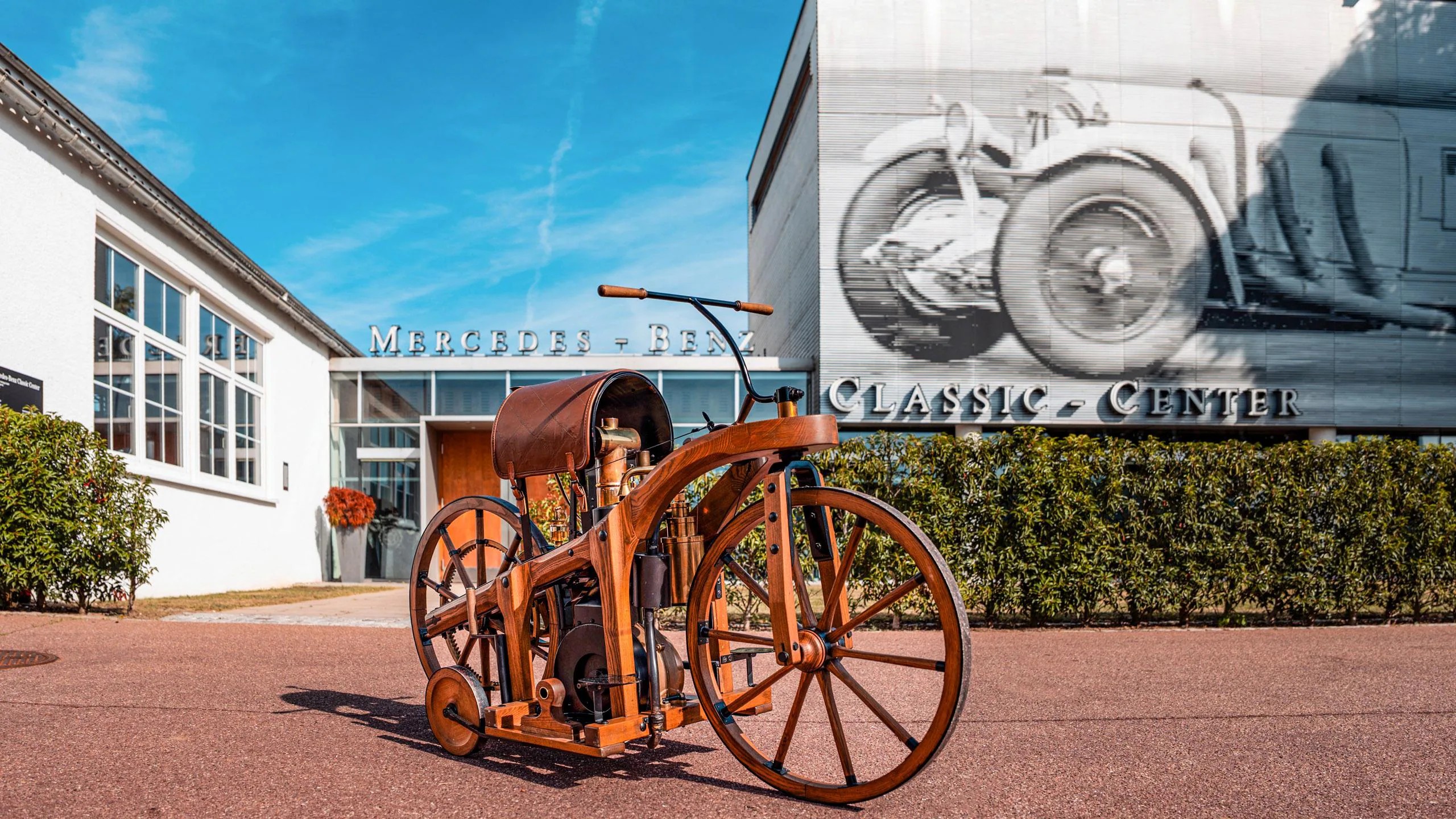
It wasn't supposed to exist. The machine that would go on to inspire hundreds of millions of motorcycles across more than a century was never meant to be a motorcycle at all. Its creators saw it as nothing more than a stepping stone — a test vehicle for an engine they hoped would one day power a car. And yet, on a crisp November morning in 1885, a 17-year-old boy climbed aboard a wooden, iron-wheeled contraption in a small German town, rode several kilometres down the road, and — with his seat briefly on fire — inadvertently changed the course of transportation history.
That machine was the Daimler Petroleum Reitwagen. And it remains, to this day, the world's oldest recorded motorcycle.
The Two Men Behind the Machine
To understand the Reitwagen, you first need to understand the men who built it. Gottlieb Daimler and Wilhelm Maybach were among the most driven engineering minds of the 19th century — a partnership bound together by a shared obsession with creating the perfect small engine.
Daimler, born in 1834 in Schorndorf, Baden-Württemberg, had dedicated his professional life to one overriding ambition: producing a compact, high-speed internal combustion engine versatile enough to power any form of transport imaginable. By 1872 he had risen to become technical director at one of Europe's largest engine manufacturers, where he first teamed up with Maybach. When creative and professional differences led Daimler to leave in the early 1880s, he took Maybach with him.
In 1882, the pair set up a private workshop — not in some grand industrial facility, but in the garden shed behind Daimler's home in the Cannstatt district of Stuttgart. It was here, away from the noise and politics of the corporate world, that they quietly set about reinventing the engine.
Their goal was specific and demanding: an engine capable of at least 600 rpm with genuine throttle control. Nothing available at the time came close. Existing internal combustion engines topped out at around 200 rpm and offered no throttle at all, limiting them to fixed-speed industrial applications. Daimler wanted something that breathed, responded, and moved.
By 1885, they had cracked it.
The "Grandfather Clock" Engine That Changed Everything
The engine Daimler and Maybach developed in 1885 earned an unusual nickname: the "grandfather clock engine." Its tall, narrow profile bore an uncanny resemblance to a standing pendulum clock — a quirky appearance that belied the significance of what was happening inside.
This single-cylinder, four-stroke unit was a genuine leap forward. It was air-cooled, keeping weight low. It incorporated a float-metered carburettor — which Daimler and Maybach themselves designed and built that same year — to mix petrol and air in precisely the right ratio. Intake valves opened automatically through the suction of the piston's stroke, and a hot-tube ignition system (a heated platinum tube inside the combustion chamber) provided the spark. The engine ran at 600 rpm and produced around 0.5 horsepower. Small numbers, but revolutionary for the era.
The trouble was, they needed somewhere to put it. Their ultimate goal was a four-wheeled carriage, but the engine wasn't yet powerful enough to move one. So, in a stroke of pragmatic genius, they mounted it in the lightest possible frame — a two-wheeled wooden vehicle they called the Petroleum Reitwagen, meaning "petroleum riding car."
An accidental motorcycle had been born.
What Exactly Was the Reitwagen?
The Reitwagen — also referred to as the Einspur, German for "single track" — looked more like a piece of Victorian furniture than anything we'd recognise as a motorcycle today. Its frame was constructed from solid beechwood. Its two wheels were wooden, fitted with iron treads rather than rubber tyres. To stop it from toppling over at rest, a pair of small spring-loaded outrigger wheels were fitted on either side, functioning essentially as training wheels.
Here's the full picture of what the world's oldest motorcycle actually was:
Specification Detail
- Frame material: Solid beechwood
- Wheels: Iron-treaded wooden wheels
- Stabilisers: Spring-loaded outrigger wheels
- Engine: 264cc single-cylinder Otto-cycle four-stroke
- Mounting: Rubber-block mounted to absorb vibration
- Power output: 0.5 hp (0.37 kW) at 600 rpm
- Top speed: ~11 km/h (approximately 7 mph)
- Ignition: Hot-tube ignition (open flame)
- Drive system: Belt drive (upgraded to two-speed ring-gear drive, winter 1885–86)
- Patent filed: 29 August 1885
A top speed of 11 km/h. Half a horsepower. Wooden wheels. By any modern measure, this was not a vehicle designed to excite. But context is everything — and in 1885, no petroleum-powered personal vehicle of any kind had ever existed before.
18 November 1885: The Day the World's First Motorcycle Ride Nearly Ended in Disaster
The Reitwagen made its maiden voyage on 18 November 1885, with Daimler's teenage son Paul in the saddle. Setting off from Cannstatt, Paul rode the machine along a route of somewhere between five and twelve kilometres, arriving at the neighbouring town of Untertürkheim.
The ride did not go without incident.
The Reitwagen's hot-tube ignition relied on an open external flame to heat the platinum ignition tube — and that flame sat directly beneath the rider's seat. Inevitably, mid-journey, the seat ignited. Paul Daimler, to his considerable credit, kept his composure and completed the journey regardless, albeit with rather more urgency than originally planned.
Despite this inauspicious debut, the significance of what had just happened was immense. A petrol-powered internal combustion engine had successfully propelled a two-wheeled vehicle under its own power, carrying a human passenger, along a public road. It was the first time in history that had ever occurred. The age of the motorcycle — and, by extension, the age of the motor car — had begun.
Is the Reitwagen Really the World's Oldest Motorcycle? The Debate Explained
Calling the Reitwagen the world's oldest recorded motorcycle is accurate, but it comes with a small asterisk — because history, as ever, is complicated.
Two steam-powered two-wheelers preceded the Reitwagen by several years:
The Michaux-Perreaux Steam Velocipede (c.1867–1871): French engineer Louis-Guillaume Perreaux attached a small steam engine to a Michaux velocipede bicycle frame sometime in the late 1860s or early 1870s. Precise dating is impossible due to a lack of surviving documentation.
The Roper Steam Velocipede (c.1869): American inventor Sylvester Roper developed his own steam-powered two-wheeler around the same time, and continued refining it for the rest of his life. He was killed in 1896 during a test ride of a later version, reportedly having just broken a speed record.
Both machines have genuine claims to the title of "world's first motorcycle" — but only if steam power qualifies. The argument against is a practical one: steam transportation turned out to be a technological dead end. The internal combustion engine became the foundation of all motorised transport that followed. As one technical authority on the subject put it, history follows things that succeed, not things that fail.
The Oxford English Dictionary lends additional weight to the Reitwagen's claim, defining a motorcycle specifically as a vehicle powered by an internal combustion engine. Under that definition — the one most widely accepted by historians and the automotive industry alike — the 1885 Daimler Reitwagen stands unchallenged as the world's oldest motorcycle.
From Test Vehicle to Abandoned Prototype: What Happened Next
The Reitwagen's working life was remarkably short. By the end of 1885 it had served its primary purpose — demonstrating that the "grandfather clock" engine could power a moving vehicle — and Daimler and Maybach's focus shifted swiftly to their real target: a four-wheeled automobile.
Over the winter of 1885 to 1886, they upgraded the Reitwagen's drive system from a simple belt to a more sophisticated two-stage transmission using a ring gear on the rear wheel. But this was refinement, not reinvention. By 1886 the machine was largely redundant. The world's oldest motorcycle was quietly set aside.
Its story ended tragically in 1903, when a catastrophic fire swept through the Daimler-Motoren-Gesellschaft factory in Cannstatt, destroying the original Reitwagen along with much of the plant. The machine that started it all no longer exists in its original form.
What does survive are a handful of carefully constructed replicas, which can be seen at:
- Mercedes-Benz Museum — Stuttgart, Germany
- Deutsches Museum — Munich, Germany
- Honda Collection Hall — Twin Ring Motegi, Japan
- Barber Motorsports Museum — Birmingham, Alabama, USA
From the Reitwagen to the Modern Road: A Timeline of Early Motorcycle History
The world's oldest motorcycle may have been abandoned by 1886, but the spark it ignited kept burning. Here's how the industry developed in the decades that followed:
1894 — Hildebrand & Wolfmüller (Germany) The first motorcycle to enter mass production. Built in Munich, it was also the first machine to be officially sold under the name Motorrad — the German word for "motorcycle," which Hildebrand formally trademarked in 1894. Surviving examples are among the most valuable antique motorcycles in existence, with one selling at Bonhams for close to €200,000 in recent years.
1896 — Excelsior Motor Company (United Kingdom) Britain's first domestic motorcycle enters production, marking the beginning of the UK's long and proud motorcycling heritage.
1898 — Orient-Aster (United States) America's first production motorcycle arrives, setting the stage for what would become one of the world's most passionate riding cultures.
1898 — Peugeot (France) The French giant unveils its first motorcycle at the Paris Motor Show. Remarkably, Peugeot continues to manufacture motorcycles today, making it the longest-running motorcycle brand in existence.
1903 — Harley-Davidson (United States) Founded in a small Milwaukee shed (echoing, perhaps, Daimler's own garden workshop), Harley-Davidson would grow into one of the most iconic names in motorcycle history.
By the mid-20th century, following the Second World War, Japanese manufacturers — Honda, Yamaha, Suzuki and Kawasaki — entered the global market and rapidly became the dominant force in motorcycle production worldwide.
The Reitwagen's True Legacy: Far Bigger Than Motorcycles
It would be easy to view the Reitwagen purely through the lens of motorcycle history. But its significance stretches far beyond two wheels.
The "grandfather clock" engine that Daimler and Maybach developed in that Cannstatt garden shed was the direct predecessor of the modern automobile engine. It influenced the development of marine engines and, eventually, aircraft engines. When the Wright Brothers flew at Kitty Hawk in 1903, the engine powering their Flyer was the direct technological descendant of the same principles that Daimler and Maybach had proved on that wooden two-wheeler eighteen years earlier.
Every car, every truck, every boat with an inboard motor, every light aircraft — all of them owe a debt to a machine with half a horsepower and a tendency to set itself on fire.
Gottlieb Daimler is often called the "Father of the Motorcycle." In truth, he might more accurately be called the father of personal motorised transport in its entirety.
Why the Story of the World's Oldest Motorcycle Still Resonates
There is something enduringly compelling about the Reitwagen's story — not despite its humble origins, but because of them. Two engineers in a garden shed. An engine nicknamed after a clock. A teenager riding through the German countryside with his trousers on fire. These are not the ingredients of a carefully planned revolution.
And yet that is precisely what it was.
The motorcycle industry today is global, multibillion-pound, and breathtakingly sophisticated. Machines capable of exceeding 300 km/h share a direct conceptual lineage with a wooden frame doing 11 km/h through the outskirts of Stuttgart. Every twist of a throttle, every lean into a corner, every rumble of an engine at idle connects modern riders to that first, chaotic, fire-singed journey in November 1885.
The Daimler Reitwagen didn't just start the motorcycle. It started the motorised world.
Key Facts: The 1885 Daimler Reitwagen
- Year created: 1885
- Inventors: Gottlieb Daimler & Wilhelm Maybach
- Built in: Cannstatt, Stuttgart, Germany
- Engine displacement: 264cc
- Horsepower: 0.5 hp at 600 rpm
- Maximum speed: ~11 km/h (7 mph)
- First rider: Paul Daimler, age 17
- First ride date: 18 November 1885
- Patent registered: 29 August 1885
- Fate of original: Destroyed, Cannstatt Fire, 1903
- Where to see replicas: Mercedes-Benz Museum; Deutsches Museum; Honda Collection Hall; Barber Motorsports Museum
Final Thoughts
The 1885 Daimler Reitwagen is a machine that rewards closer inspection. On the surface, it is a curiosity — primitive, fragile, borderline dangerous. Look deeper, and it is one of the most consequential inventions in human history. Not because Daimler and Maybach set out to change the world, but because they followed an engineering problem wherever it led — and it led somewhere nobody had ever been before.
That spirit of curiosity, of testing what's possible, of solving problems with whatever materials are to hand — it's the same spirit that drives motorcycle engineering today. Next time you ride, you're part of a story that began in a garden shed in Germany, 140 years ago.